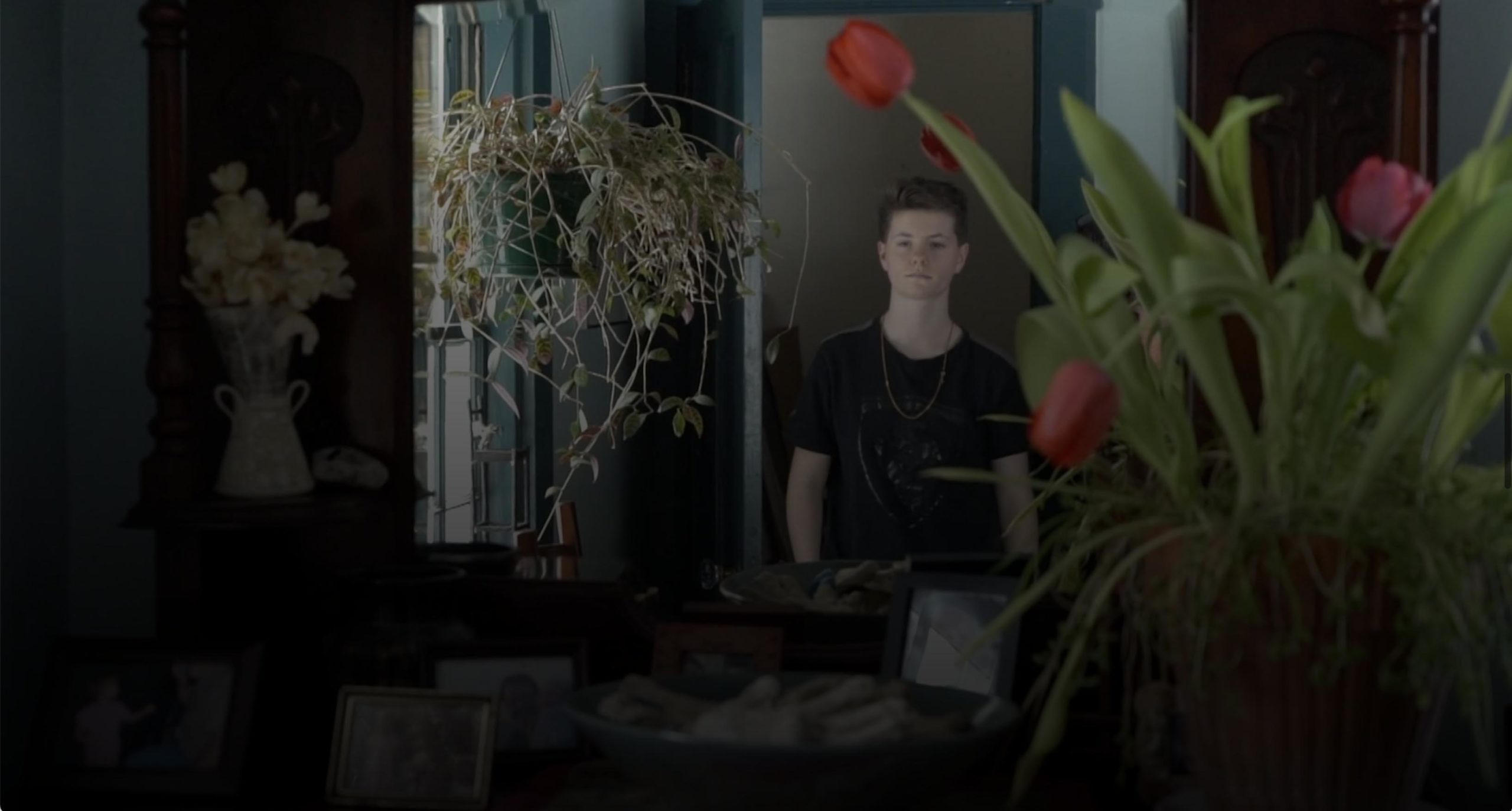
A feature film currently in early production, ADAM’S APPLE is an unconventional coming-of-age documentary from the perspectives of Director Amy Jenkins and her teenage transgender son, Adam. Collaboratively they will trace the transition of Adam from pre- pubescent Audrey to evolving-young-man Adam in an exploration of what characterizes “maleness” for today’s gender-redefining youth.
The film’s production will continue through 2022. Planned release is early 2023.
DIRECTOR/PRODUCER: Amy Jenkins is an award winning, American artist whose installations, films, and photography have been shown at museums including MoMA, NY; National Gallery of Art, Washington, DC; Haifa Museum, Haifa, Israel; Akron Art Museum, Ohio; and Palm Beach ICA, FL. Jenkins’ first documentary feature, Instructions on Parting, won Best Feature Documentary at Athens International Film and Video Festival, OH, and screened at festivals including Museum of Modern Art Doc Fortnight 2018 (Premiere), Montclair, IFFBoston, Sydney, and DOXA. Jenkins was awarded the 2019 Ewing Award for Interdisciplinary Art, and 2018 Filmmaker of the Year by New Hampshire Film Festival. A Robert Flaherty Film Seminar Fellow, her work has also been supported by LEF Foundation, Perspective Fund, IFP, Points North Institute, NH State Council for the Arts, the Pollack-Krasner Foundation, NYFA, Jerome Foundation, NYSCA, Berkshire Taconic A.R.T. Fellowship, Aaron Siskind Foundation, and the Experimental Television Center. Reviews include The New York Times, ARTnews, Bomb, Performing Arts Journal, and The Village Voice.
DP/CAMERAPERSON: Katy Scoggin is an award-winning documentary filmmaker, producer, and camerawoman. She studied film directing and cinematography at NYU. She worked for Laura Poitras for six years, during which she was Co-producer and Cinematographer on the Oscar- winning CITIZENFOUR, a Co-Producer on RISK, and an Associate Producer on The Oath. Throughout 2016, she filmed on the American campaign trail for filmmaker and Field of Vision co-founder AJ Schnack. In addition to her camerawork, she is currently completing her first feature documentary, “Flood.”
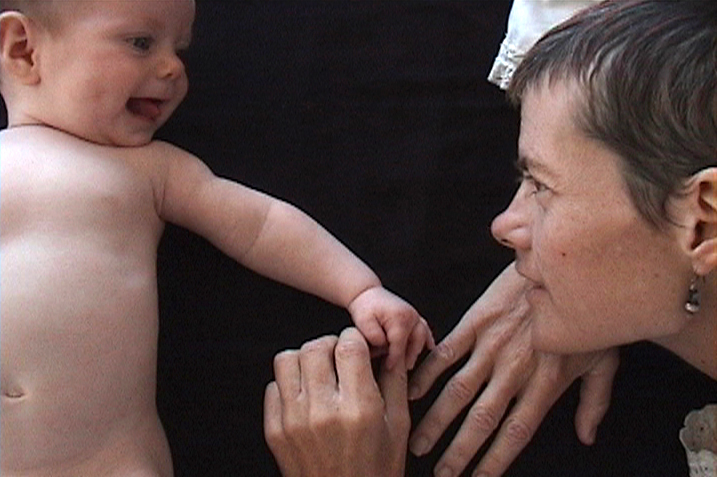
Instructions on Parting is a feature-length documentary film. The World Premiere was held at The Museum of Modern Art, Doc Fortnight 2018 in NYC.
SYNOPSIS: Instructions on Parting weaves breathtaking artistic footage with cinéma vérité to tell an elegiac story about transformation, grief, and the essential nature of the collective human journey. Told in an unconventional visual style, the story evolves from the viewpoint of Director Amy Jenkins, whose first child is born while she negotiates the cancer diagnosis and slide toward death of three of her closest family members. By chronicling with her camera to interrogate loss, the filmmaker leads us to a bold and daring acceptance of our inevitable end.
Clips from the film are available to view at the Instructions on Parting Website. See also the film’s Facebook Page.
“Instructions on Parting” is supported through the generous assistance of the Vermont Studio Center Clowes Fellowship and the Berkshire Taconic Artist Fellowship
RT: 12:30 minutes
An experimental film documenting a first and a second haircut, Becoming (part one & part two) is inspired by the ancient ritual of a son’s first haircut at age three, the age when one relinquishes the gender neutrality of babyhood for boyhood and when self-control begins. Throughout history hair is a signal of strength on the part of the bearer or of the taker. Becoming is a meditation on the concept of power—the power of the child as an individual, both in balance and in collision, with parental power.
Please contact the artist for a link to the film on Vimeo.
RT: 08:30 minutes
In the wake of rampant “luxury” development that doomed our Brooklyn neighborhood, Don’t Fall in Love with Buildings was filmed with a surveillance camera in time-lapse during the last five weeks of the eviction from our Williamsburg, Brooklyn loft at 72 Berry Street, our home for over fifteen years. The title comes from the anonymous graffiti spray-painted on our door in the weeks before we vacated. Raw and unadorned, the physical and emotional process of leaving one’s long-term home is poignantly revealed.
Link to the video on Vimeo: https://vimeo.com/41173363
RT: 05:30 minutes
A newlywed waltz, a strip tease, a hoarder’s paradise, an attic trove…
To Have and To Hold is an animation of a bed slowly spinning to the music box tune “Honeymoon Waltz” as it unmakes itself down to bare bedposts. One by one, discarded possessions begin to rain down onto the bed. A chair, a crib, clothing, holiday decorations and random keepsakes–the stuff of attics–build on the bed into a precarious mound. From the possibility of romance to the inevitable accumulation of domestic excesses, the little bed and its plethora signify the history of living.
Link to the film on Vimeo: https://vimeo.com/39798340
RT: 09:00 minutes; High Definition video
“I wanted to be a boy when I got borned, you know, outta your tummy!”
-Audrey, age 6.
Audrey Superhero, an experimental documentary, explores the shifting terrain of gender identity. The film includes vividly charged discussions with Audrey, who insists she is Superman. Playful and arresting, Audrey de-cloaks from Clark Kent to Superman, revealing her “secret identity” as a boy. She does push-ups, practices flying, vehemently declares “I wanted to be a boy when I got borned, you know, outta your tummy!” and imagines “saving the police from the bad guy,” all the while drawing us into her state of transformation. The unscripted narrative is built through the collaboration of mother and daughter; Audrey is youthfully honest and willing to reveal her inner emotional state. She is open as only a six year old could be.
Audrey Superhero was originally funded by and exhibited at ATHICA: Athens Institute of Contemporary Art, Georgia. Thus far it has screened at Anthology Film Archives, NYC; Three Rivers Film Festival, PA; and Athena Film Festival , NYC; among others.
Please contact the artist to see the film in its entirety or to learn more about Audrey Superhero.
RT: 09:00 minutes; High Definition video
“I wanted to be a boy when I got borned, you know, outta your tummy!”
-Audrey, age 6.
Audrey Superhero, an experimental documentary, explores the shifting terrain of gender identity. The film includes vividly charged discussions with Audrey, who insists she is Superman. Playful and arresting, Audrey de-cloaks from Clark Kent to Superman, revealing her “secret identity” as a boy. She does push-ups, practices flying, vehemently declares “I wanted to be a boy when I got borned, you know, outta your tummy!” and imagines “saving the police from the bad guy,” all the while drawing us into her state of transformation. The unscripted narrative is built through the collaboration of mother and daughter; Audrey is youthfully honest and willing to reveal her inner emotional state. She is open as only a six year old could be.
Audrey Superhero was originally funded by and exhibited at ATHICA: Athens Institute of Contemporary Art, Georgia. Thus far it has screened at Anthology Film Archives, NYC; Three Rivers Film Festival, PA; and Athena Film Festival , NYC; among others.
Please contact the artist to see the film in its entirety or to learn more about Audrey Superhero.
A gigantic baby, projected onto the wall eight feet in height, looks serenely out at the viewer. The baby, a painted rendition of the Gerber baby, seems vaguely familiar. Suddenly, a life-sized woman, naked, toddles across the baby in a pre-nap fit, eventually crawling onto its lap. The woman gurgles a little, looks up at the baby’s face, and collapses exhaustedly, proceeding to fall asleep. Her fingers slowly uncurl and her mouth opens in relaxation. A short while later, after awaking, the woman attempts to receive some response from the baby, but to no avail. Untended, she slowly crawls off the lap of the baby and exits. In Held, the illusion of the big baby cradling the sleeping mother is an ironic twist on motherhood and the common need to be nurtured.
Installation photos from solo exhibition at ATHICA, GA, 2010.
RT: 08:00 minutes
Sea of Remembering is a voyage into an aqueous repository of domestic objects such as clothing, furniture and toys. Memory-based reflections of home, family and childhood carry us into the depths of reverie. Whether submerged by natural disaster, lost, discarded or forgotten, there is an emotional resonance that these iconic possessions carry in our psyche.
Like the fleeting moments just before the dream-state ends, in the final minutes of Sea of Remembering there is a turning point in the journey of recollection. As if awakening or coming up for air, we move through time and memory, ascending skyward, ultimately crossing the threshold between memory and reality.
Running time: 03:00 minutes
In From the Same Water, a miniature pool stands in the center of the darkened room; rear-projected inside the miniature pool a male figure, floating face up, slowly sinks underwater and is obscured. When the figure reappears, it is a female who floats to the surface. The floating and sinking repeats in slow, meditative motion, accompanied by the sound of water, exhaling breath, and cicadas. The alternating figure brings to mind the relationship between male and female, brother and sister, as well as the intimation of both genders being contained within one body.
The title From the Same Water refers to amniotic fluid as well as to the passages of birth and death. The tie of male and female is broken when the male figure submerges and does not reappear. Flesh becomes water, akin to spirit.
The artist and her brother, Craig Jenkins, enacted the floating and sinking. From the Same Water is dedicated to Craig Jenkins, who recently died of cancer.
Running time: 13:30 minutes
It is early December, in the weeks just before the winter solstice. Darkness comes early, and shoppers are out at dusk on Grove Street, Peterborough, shopping for the holidays. Imagine their surprise to find the Peterborough Historical Society seemingly filled with water! Through Amy Jenkins’ art of video installation, the building comes alive with an underwater environment as dusk falls. And it is no ordinary underwater environment, but one with objects set loose under the current: a chair, a swing set, a dress. Appearing in slow motion magic and drifting out of view, the buoyancy of water sets our desires afloat.
A joyful discovery for the child, a contemplative experience for the adult—Water Windows inspires memory-based reflections. Investigating the personal relationships attached to everyday objects such as clothing, furniture and toys, the aqueous void becomes a repository for the emotional resonance that possessions carry in our psyche. This search for meaning in the material is especially pertinent in the holiday season.
Another counterpoint offered by the under-water world during chilly holiday shopping sprees is the reminder of New Hampshire summers, of warm water and Saturday afternoon swims. All of the underwater footage was filmed in local ponds and lakes, such as the crystal clear waters of Willard Pond in Hancock. The breath of summer warms the shopper’s feet and helps float their load (perhaps just a little bit lighter?) down to Main Street.
“Art, Water and Serendipity on Grove Street”
Click to read feature article on “Water Windows” by Jane Eklund
Monadnock Ledger Transcript
December 17, 2007
Suburban life in a nutshell—marriage, house, baby, meals, the child growing up and life gone awry… all told in a surreal story of metamorphosis where the miniature and the gigantic collide and engagingly set to Bach’s Goldberg Variations, (played by Glenn Gould.)
In Variations on Contrary Motion (Canon on the Fifth,) miniature objects are juxtaposed with the full-sized body or with nature. Tiny furniture within a vast, life-sized room, paper houses suspended in mid air, a tiny rotating bed that surfaces several times both as miniature and as full-sized, a music box couple stuck in repetition, the butterfly just emerged from cocoon and later in flight, baby legs dancing a jig to Bach and adult legs scaling furniture, tiny spoons and forks with an insect, a little carriage on a large pregnant belly and later another small carriage falling off a bed, the dollhouse penetrated by the full-sized adult, swing sets both real and pretend in motion… these are just a few of the images that transpire in this story of the common life in it’s various emergent and inevitable forms.
Notes on the title and the musical score:
Bach’s Goldberg Variations is an aria followed by thirty variations. The one used in this piece is the fifteenth variation. It is the turning point in the group of musical pieces, when the Canon is inverted. Within the fifteenth variation, called “Canon on the Fifth,” a technique of “contrary motion” is used, where two melodic lines move in opposite directions. At the end of this piece, the hands of the pianist move in opposite direction of one another while playing. This “contrary motion” technique is echoed in the filming technique of the sequences within the video.
A tiny LCD video monitor showing a life-sized breast viewed from below is suspended just above head-height. Perilously clinging to the nipple is a single droplet of milk, which in a matter of minutes falls from the nipple and obscures the view of the breast. Tenderly, the woman wipes the droplet away, as if “cleaning up” the viewer who has just been “dripped on.”
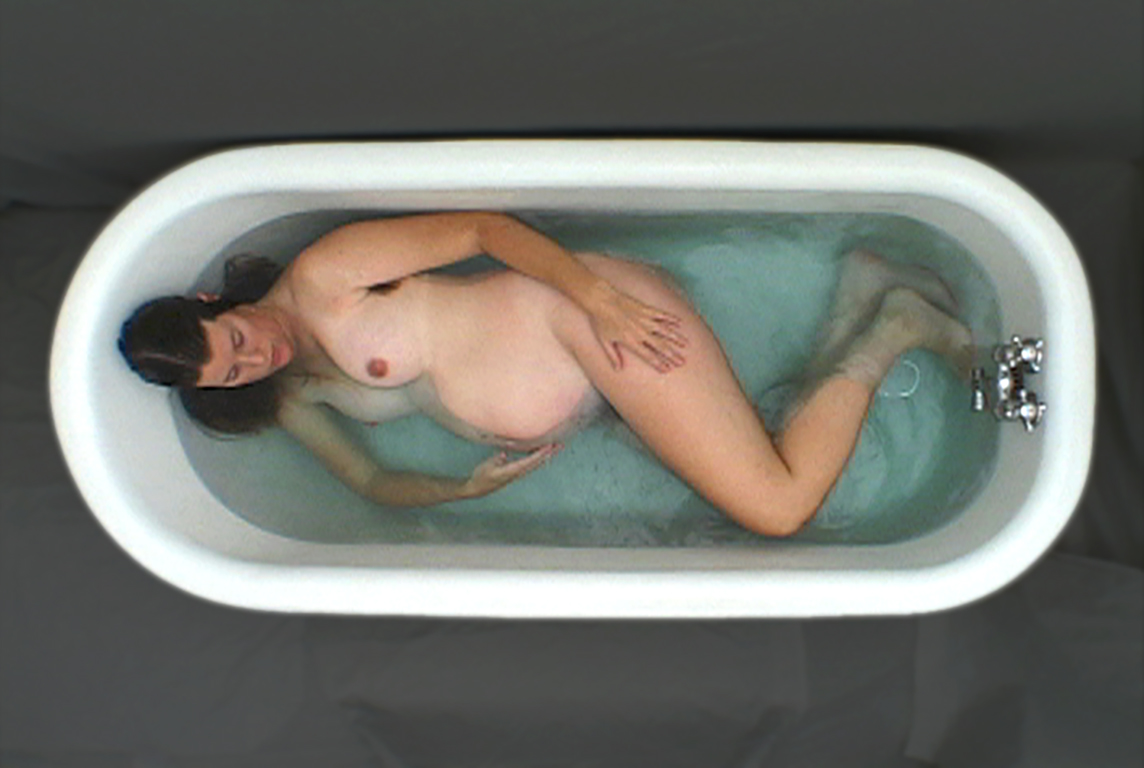
Flow is an allegory for the act of creating, or bringing forth, from the self. Filmed during the artist’s pregnancy, this nine-minute piece (one minute per month) combines the sculpture of a miniature bathtub with video projection. In the installation, the projected image of water fills the miniature tub into which a woman climbs, crossing the static bounds of space and object. As the woman bathes, one begins to notice a subtle change to her body: with her swaying motions in the water, her belly begins to swell in apparent pregnancy. Flow is edited in a manner so that the bathing appears to be continual, with a building apex as the woman approaches full-term pregnancy.
Throughout history, water has been a metaphor for fertility; water has figured in a number of Jenkins’ artworks, as a metaphor for the subconscious, as well as for its ritual aspects. Flow is a companion work to Jenkins’ 1996 work, Ebb, which is also a projection into a miniature tub.
Flow was supported with a Finishing Fund Grant from the Experimental Television Center, NY.
–Installation components: video projection on miniature ceramic tub and tiled pedestal, audio; tub sculpture dimensions: 9h x 24w x 12.5d”; original running time: 9 minutes 31 seconds.
Shown on a large LCD panel placed on the floor, Give addresses the complexities of self-protection, nurturing, and sexuality. The view presented is a recumbent woman seen from above, who slowly and sensually removes from her mouth what appears to be her entrails, and lays them upon her belly. The image of the woman regurgitating her own flesh is like the act of birth, as well as the act of giving sustenance from one’s own body.
The artwork addresses the act of creating, or bringing forth, from the self. It is a reflection on the decision to make life, as well as upon the responsibility of giving of oneself to that life. Give explores the fearsome fragility of life, yet draws no conclusion. Rather, it shows the circular act of creation and destruction inherent in living. Give is also a return to a performative aspect of my work, after a several year hiatus in which I was firmly planted only behind the camera.
Running Time 11:48
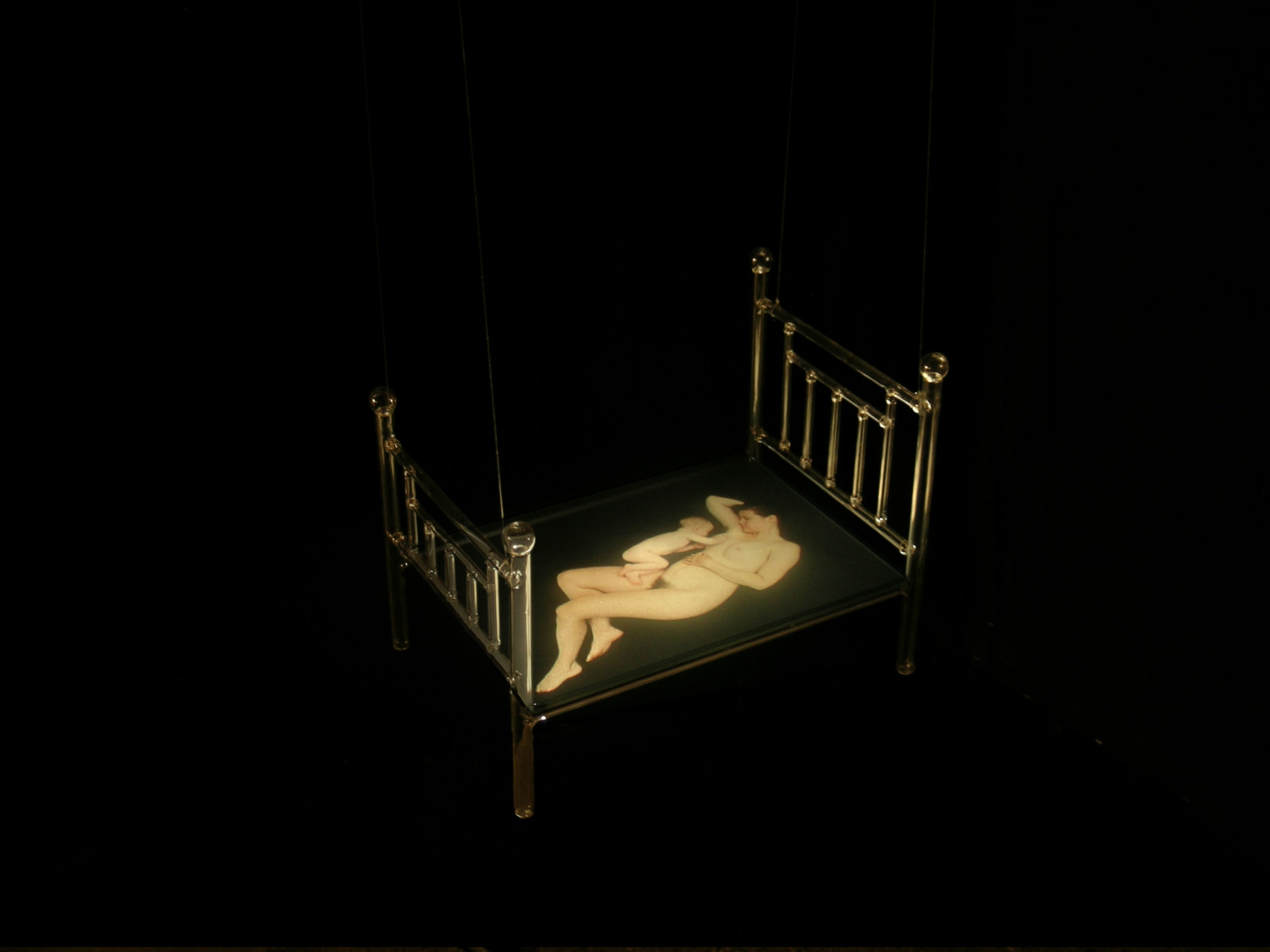
Nightfeeding explores fragility, delicacy, and need in infancy. In the installation, a miniature glass bed is precariously suspended from a tree limb. Projected onto the glass bed’s surface is a video of an infant awakening, being comforted and nursed back to sleep. Illuminated solely by the video light, the fragile bed glows like a beacon, while murmurs of the “Cradle Song” rise and fall.
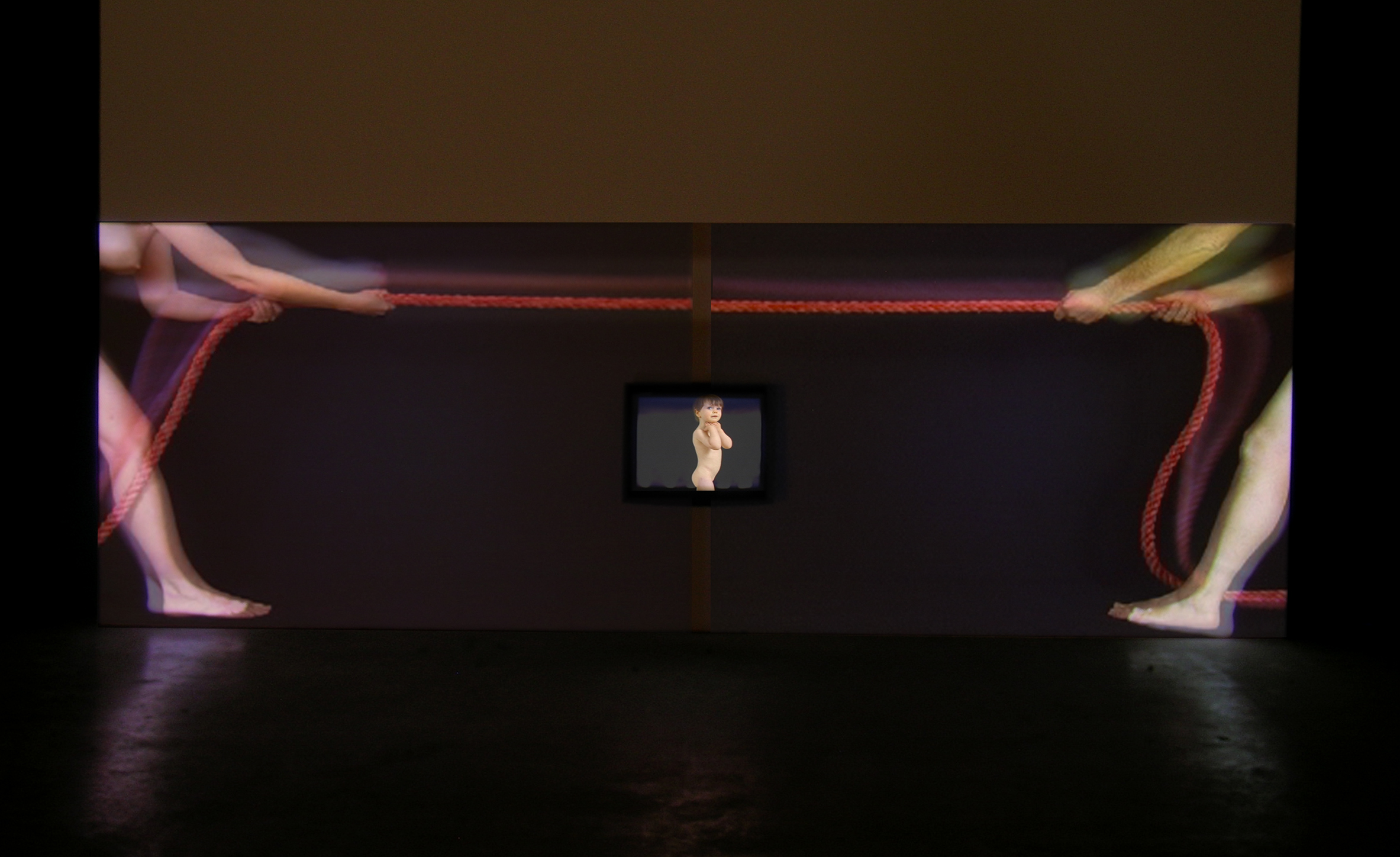
“Tug” is a 3-channel video installation symbolizing the tension and harmony within parenthood. A couple struggles at tug-of-war in a life-sized, diptych projection; between them is a wall-mounted monitor showing a toddler whose movements and emotions correspond to the rope pulled between the parents. What begins as a game, teeters in back and forth sparring, and turns to an all-out struggle to hold onto one’s rope-end.
Running Time: 19:29
The Audrey Samsara is a meditative, slowly unfolding video featuring the artist’s 18-month old daughter breastfeeding, falling asleep, reawakening, breastfeeding and again falling into deep sleep. This continual cycle brings to mind the notion of the life force, hence the Buddhist word “Samsara,” meaning the cycle of death and rebirth. Drawing inspiration from renaissance painting, The Audrey Samsara echoes depictions of the Madonna and Child, as well as the Pieta, yet it is not idealized nor sentimental. Intimate and edgy, The Audrey Samsara captures the truth of the nursing experience. Ironically, in May 2004, The Audrey Samsara was censored from its first scheduled public exhibition at the New York 5th Avenue gallery of designer Salvatore Ferragamo, when a company executive found the artwork “distasteful.” It has since been exhibited internationally.
Note: The Audrey Samsara was created in the widescreen, 16:9 format, and is designed to be show on a wall mounted, widescreen plasma monitor sized from 40 to 60 inches diagonal, to approximate the look of a painting, and to show the figures approximately life size. Large-scale photographs, produced separately from the video, are also a part of The Audrey Samsara series.
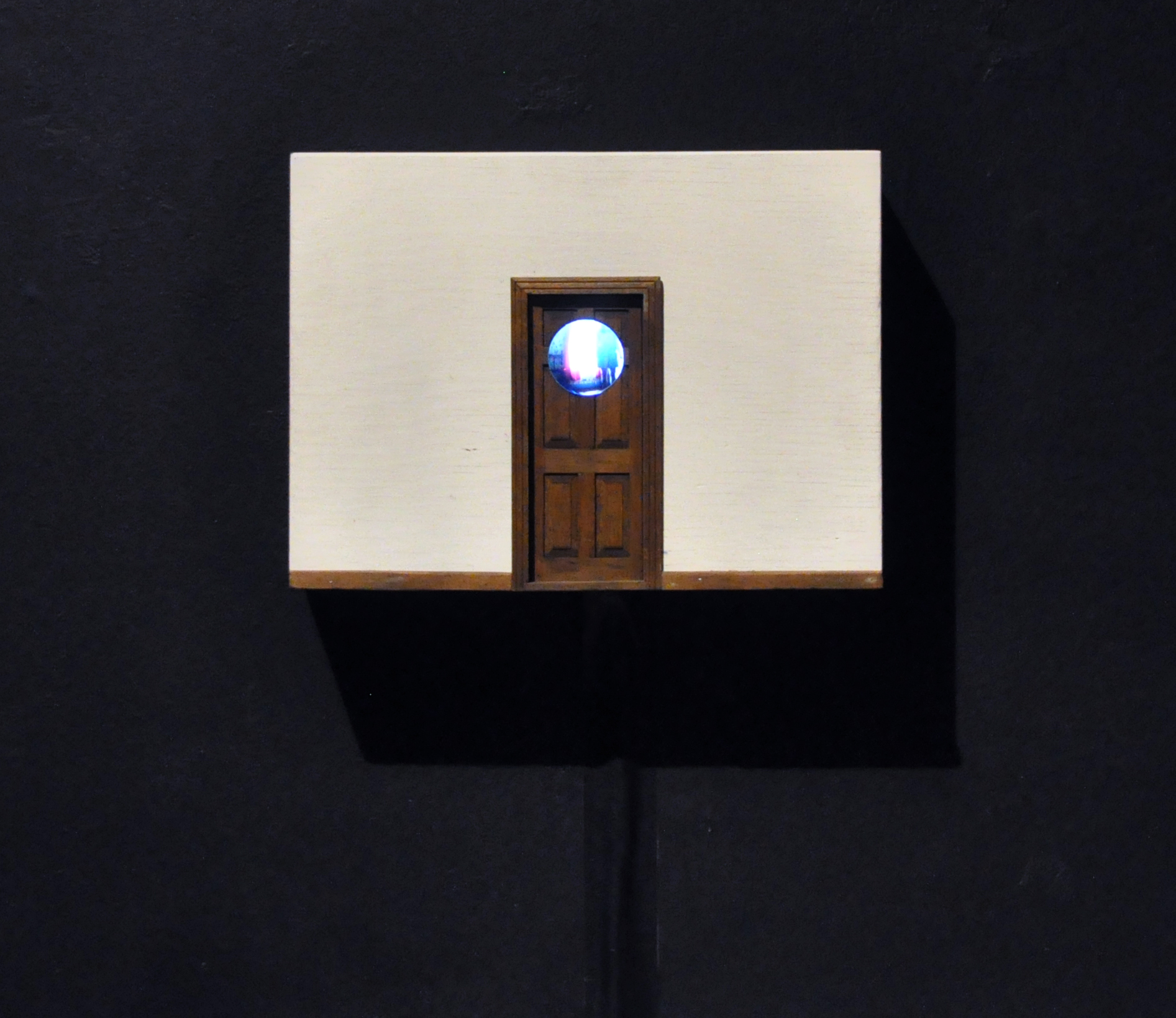
Shitfit combines a sculptural element with video. In Shitfit, a wall-mounted, miniature door containing a small lens reveals a video of a child’s bedroom interior, giving the impression of peering into a room behind the door. On closer inspection, the room appears to be abandoned, with the mattress missing and floors dust covered. A woman appears, dressed in child-like clothing, and proceeds to throw a child-like “shitfit.” At once tense and amusing, “Shitfit” exposes the latent child within us all.
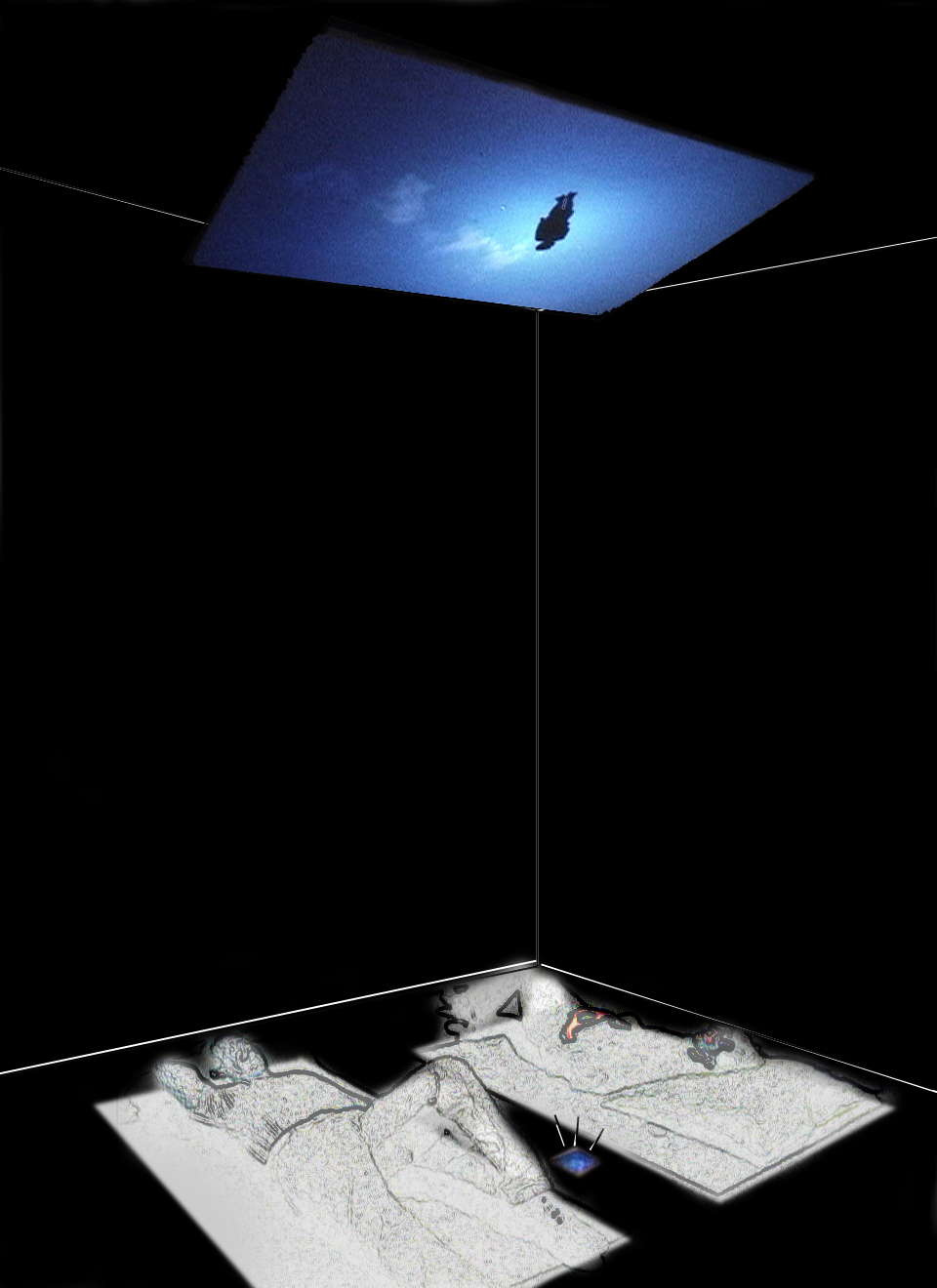
Without is a video installation in which a 5 by 6.6 foot projection is cast upon the ceiling of an intimate, darkened room. The video projector is hidden beneath a false floor, and there are floor mats and pillows for two viewers. The installation is intended to be viewed while lying down.
Altering the viewer’s sense of location by shifting the perspective upwards, Without creates a sense of relinquishment through the physical interaction of lying down. In slow-motion passage, darkened shapes form the outlines of people descending in free-fall. The viewer is swept along with the many dislocated, drifting figures descending from the sky, while the sound of muffled, indistinguishable voices give way to clarity, revealing life’s histories—births, deaths, and acts of loving, planning, working, and aging.
Without is an invocation of the persistence of memory and the endurance of familial history despite the conditions of transience and impermanence. Adrift through air, untethered to material objects, these passing figures eventually rise back into the overhead expanse in a perpetual cycle of descent and ascent.
Running time: 03:00 minutes, color
Synopsis
99.9% Sure enters the uneasy yet intoxicating world of new-found love. The short vignette of anticipation and intimacy unfolds through gestures showing only the hands and mouths of the two characters. Edgy and playful, 99.9% Sure captures the topsy-turvy, stomach-fluttering nature of coupling.
Running time: 03:00 minutes, colorSynopsis
Traces is an enigmatic, meditative consideration of the physical displacement that arrives when a romantic relationship is severed. Using line and gesture to create the articulation of body-memory, Traces alludes to the ironic and difficult situation of intimate familiarity coupled with emotional distance.
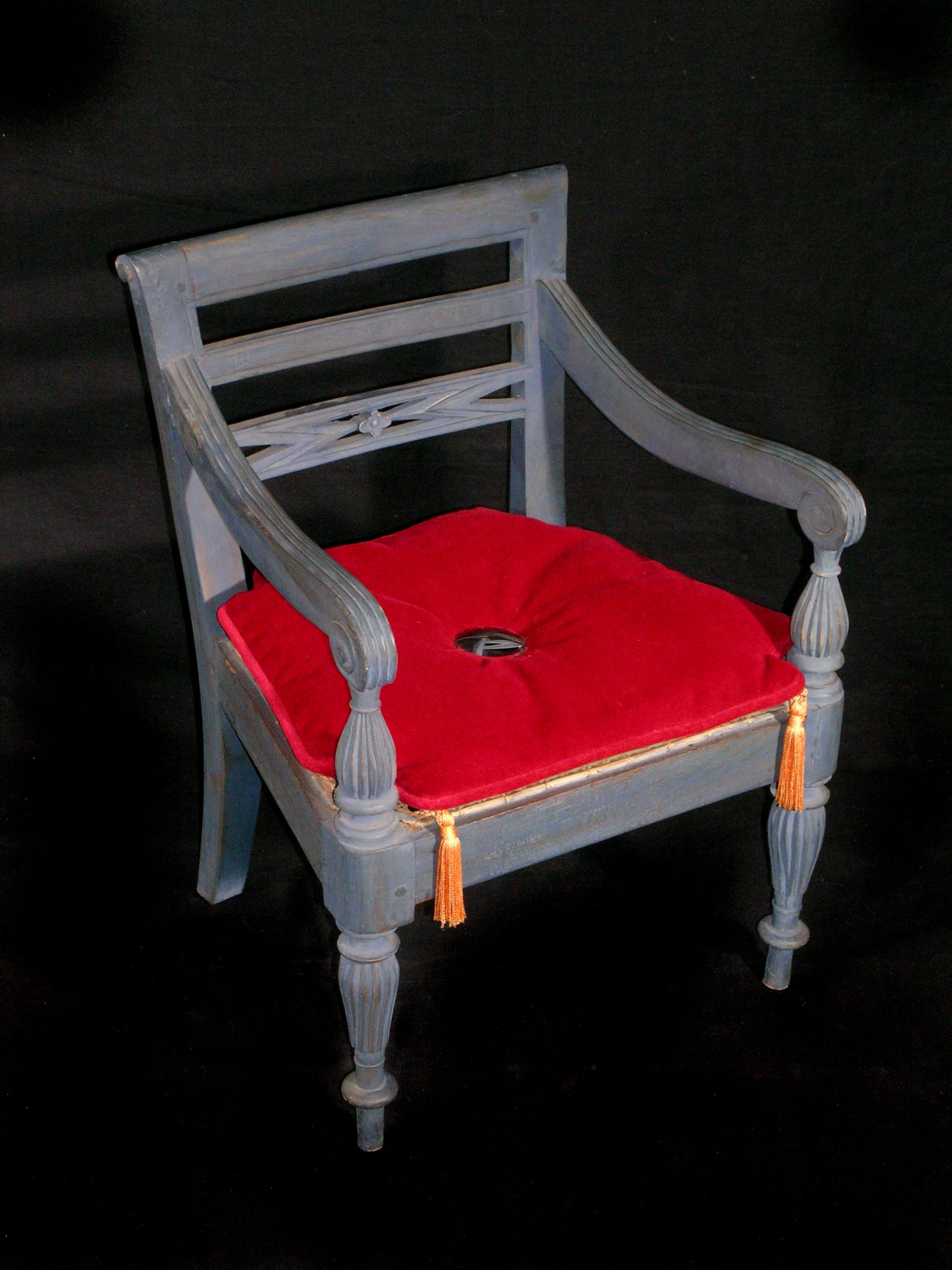
Her Majesty’s Request combines a sculptural element with video. From afar, Her Majesty’s Request appears to be a child-sized Chippendale-style chair with a plush, red velvet cushion. Drawing nearer, the viewer may begin to hear quiet kissing and slurping sounds which beckon for closer inspection. Standing directly over the chair, a small circular lens in the cushion reveals a pair of lips and tongue, gesturing and kissing. The fetishistic quality of the tiny chair combined with the voluptuous lips gives a push-pull impression of come-hither attraction and queasy disdain. At once edgy and amusing, Her Majesty’s Request beckons and mocks with sweet subversiveness.
Installation Components:
–Mixed-media video installation with3-inch LCD monitor and lens embedded within a miniature chair, with audio. Sculpture dimensions: 19 x 13 x13 inches.
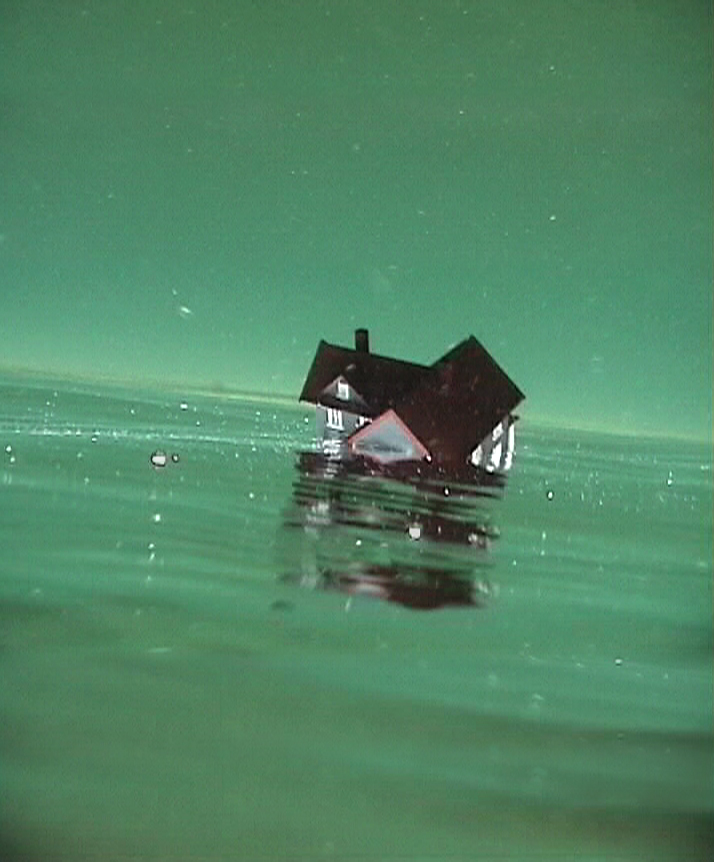
Shelter for Daydreaming is a two-channel video which invokes the netherworld of “In-Betweeness.” Projected large-scale onto a free standing, “floating” wall centered within the gallery, the first channel of video shows a small house seemingly suspended in an aqueous region which is without gravity, yet is somehow tethered to the movement of the underside of waves. It is a placeless place, without definition or boundary. The sounds of a world underwater pulsate with the movements of the house. Occasionally, a wave will lift from the base of the house, revealing its underside, which is firmly seated within an entirely different place– it is the “above-world,” yet this place appears from underneath. Revealed in this momentary flash are trees and a landscape which point downwards, becoming the roots which temporarily stabilize and give location and mass to the house. As quickly as this under/aboveworld appears, it is obscured by the resettling of the wave and the viewer is returned to the isolated, aqueous void into which the house (and the viewer) are slowly being pulled.
The second channel of Shelter for Daydreaming is projected onto the opposite side of the same, free standing wall in the center of the gallery. This large-scale projection shows the interior of an empty house. The view focuses on two rooms, separated by a central wall; the interior sways back and forth as if contained within a boat. The fluid movement can be mesmerizing and meditative, yet also unstable and precarious. To reinforce the notions of interior/exterior, above/below, the movements of the interior view are timed to the surging and bobbing of the exterior view of the miniature house in the first channel of video. Imitating the split -view within the second channel of video, the installation itself is constructed so that the viewer will approach the installation seeing only the thin edge of the free-standing wall in the center of the gallery. Both channels of audio are audible. The viewer will choose to first view the work from either the left or right side of the wall. The audio will then draw them to the other side of the wall to experience the second channel. The large-scale projections both contain fluid, rocking motions that can physically affect the viewer’s equilibrium.
Shelter for Daydreaming summons a feeling of being on a voyage through water and air with no destination named. As if in a daydream, the fluid movement of the video is mesmerizing and meditative, yet also unstable and precarious. There is a sense of searching and isolation, the desire to find a home. Addressing the notions of interior and exterior, above and below, Shelter for Daydreaming invokes the netherworld of “In-Betweeness:” To be without origin, floating somewhere between the solid and the fluid, somewhat awake, yet far away from an actual place.
Shelter for Daydreaming Exhibition dates:
Premiere: John Michael Kohler Arts Center, Sheboygan, Wisconsin; Solo exhibition and catalog, Shelter for Daydreaming, November 2000 to February 2001
Julia Friedman Gallery, Chicago, Illinois; Solo exhibition, Shelter for Daydreaming,
October to December, 2001
Aquaria; Group Exhibition; Oberösterreichisches Landesmuseum in Linz, Austria (January – March 2002)
Städtische Kunstsammlungen in Chemnitz, Germany (April/May 2002)
Sioux City Art Center, Iowa: Solo exhibition and catalog, January 2004 to April 2004
Shelter for Daydreaming was made possible in part with funds and in-kind support from: The New York State Council on the Arts, The Jerome Foundation, The Experimental Television Centre, Harvestworks Media and Art Centre, and the MacDowell Colony.
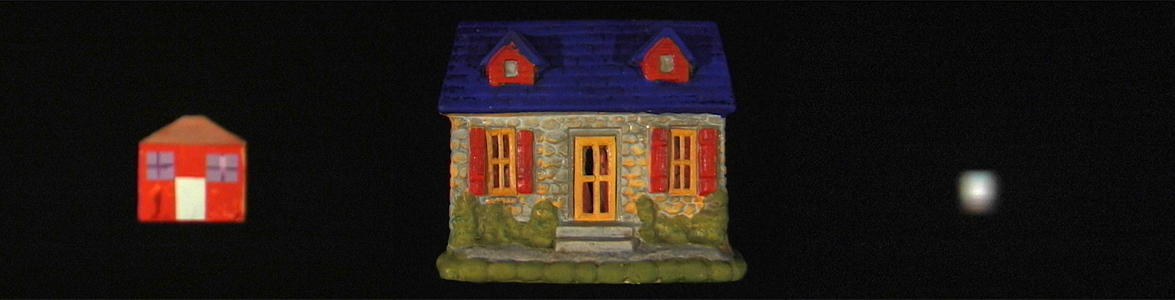
A video installation with three channels of video and audio
Based upon the memories and dreams we associate with our past, present and future homes, Almost Home is a triptych of large-scale projections showing miniature, handmade houses. Made by children, each house grows in scale and focus, then retreats in slow motion movement as it fades out of the picture plane, metamorphosing into a different house. The sound of crickets, unique to each house, gathers intensity as the house approaches. Each house and its accompanying cricket ambiance is tuned to a different note on the harmonic scale, creating a virtual symphony when the three channels of audio and video are played together.
When the house reaches its peak in size and focus within the frame, the intensity of the sound and the life-size enormity of the handmade house creates a visceral impact upon the viewer which can be felt bodily.
There are three houses per video channel, or nine houses total. Each channel is timed slightly differently, so that the installation is continually evolving and different juxtapositions of houses and cricket sounds appear throughout the day. Conceptually the work focuses upon the home as a locus for memory, expectation and metamorphosis, and addresses notions of childhood idealism, variation within sameness, miniature and gigantic, and fantasy and reality.
Installation Components:
—Hardware: Three LCD video projectors, three DVD players and discs,
three pair of speakers.
–Dimensions variable. Installation can be installed with a minimum total
projected width of 18 feet to a maximum width of 36 feet (including all three
channels of video projected side-by-side on one wall)
–Installation running time: continually evolving loop.
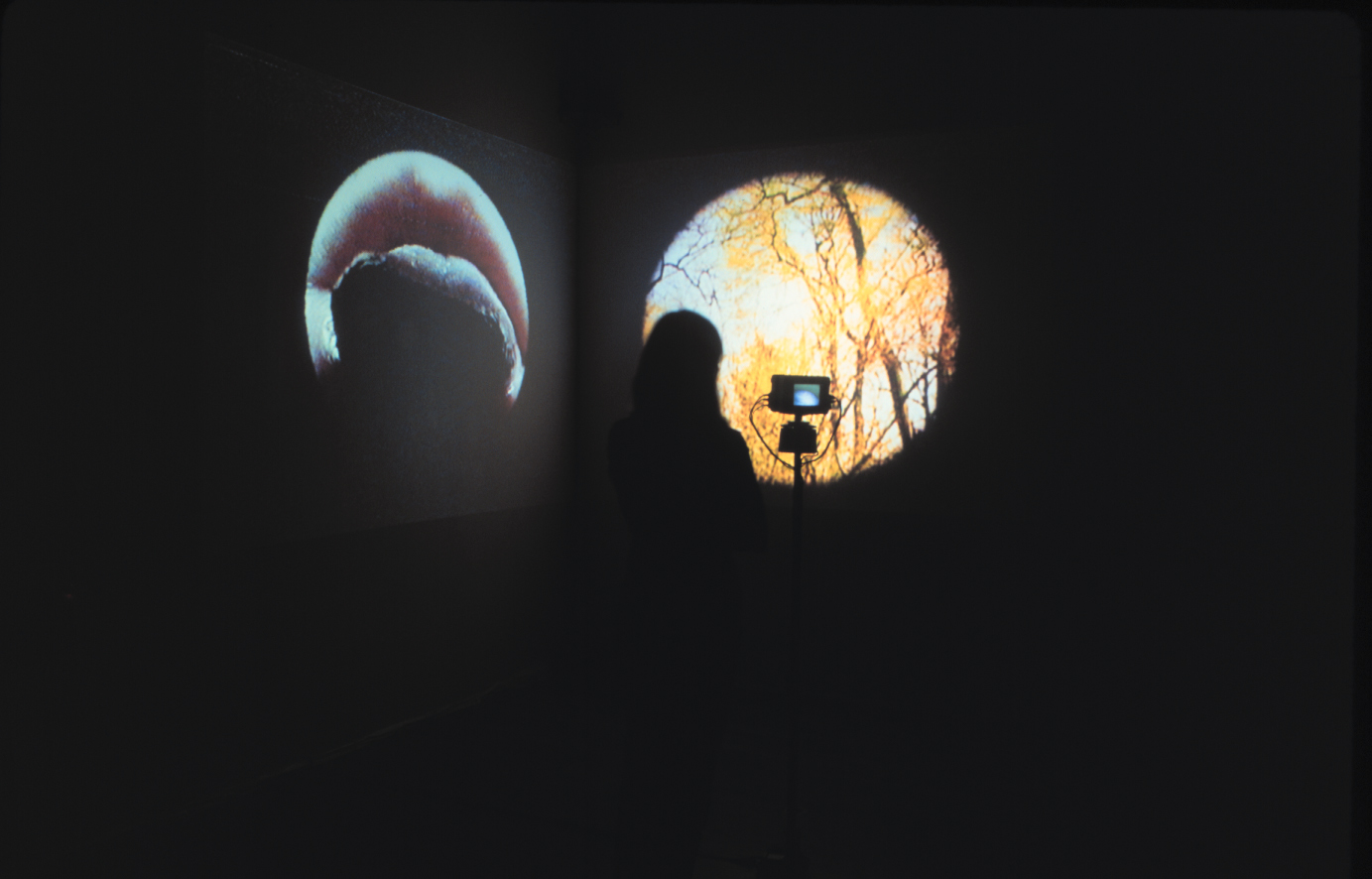
Pages from the artist’s teenage journal scroll slowly across two small LCD monitors which rotate back to back on a stand in the center of the room, revealing her thirteen-year-old quips and quandaries. She “frenches” a boy for the first time and bemoans the fact that the same week her father gave away her backyard swingset. On adjacent gallery walls are projected two large, circular images: the view from a swingset swinging back and forth and the view from the vantage of being kissed. The musical sound of a squeaking swing, the slurping sounds of kissing and the rhythmic sounds of writing heighten the atmosphere of discovery and loss.
Installation Components:
–Video installation with four channels of video and audio.
–Hardware: Two LCD video projectors, Two four-inch LCD video monitors on revolving motor, mounted on five-foot pole, four DVD players and discs, five speakers.
–Dimensions variable.
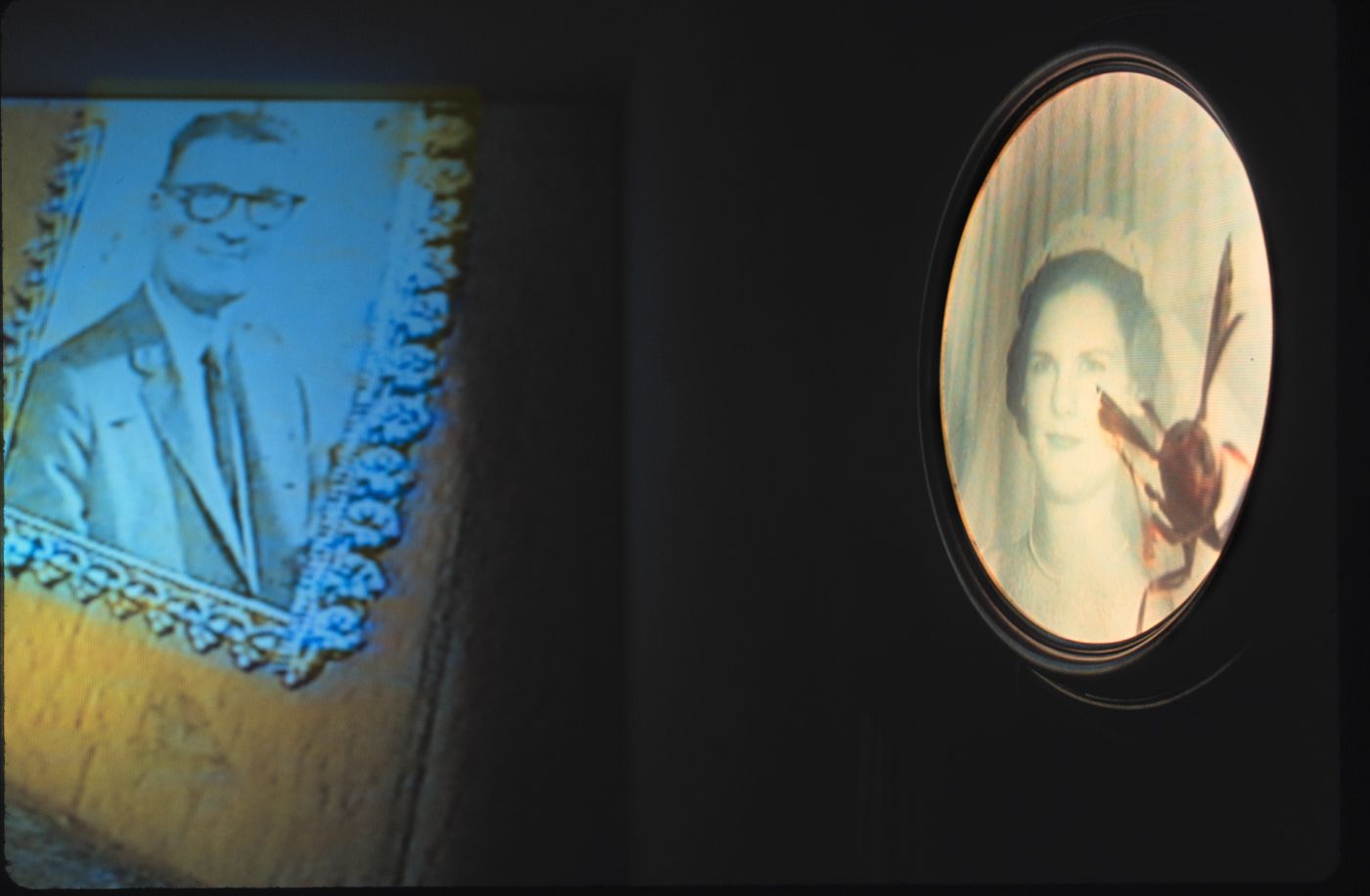
In the installation Trapped Wasp, home is portrayed as a place for potential entrapment. On the wall in a small, darkened room hangs an 11 x 14 inch gold-leaf oval frame. Rear-projected within the frame is a portrait of a bride, with a larger-than-life sized wasp seemingly trapped within the frame. An intense buzzing noise reverberates as the wasp alternates between grooming and trying to escape.
On the adjacent wall, a large video projection shows a “wasp’s view” flying through a dollhouse. The black and white image is projected life-size which gives it the appearance of an actual interior; intermittently the interior is “stung” with flashes of color within the projected image. The accompanying soundtrack of frantic buzzing heightens the sense of entrapment.
Installation Components:
–Video installation with two channels of video and audio.
–Sculpture: 11 x 14” gold-leaf oval frame with rear-projected video.
–Hardware: Two LCD video projectors, DVD players and discs, and six speakers. Dimensions variable.
Running time: 02:30 minutes, color
“Culling from her teen-age experiences, with one foot in girlhood and the other
in womanhood, Ms. Jenkins recreates the predicament of youth in her work.”
Elizabeth Hayt, The New York Times, May 10, 1998
Synopsis
Closures moves in and out of a world simultaneously lilliputian and giant. Toy houses and real houses merge. Undersized objects and oversized humans collide. The landscape of the home as viewed by the adolescent – its illusion of stability, its memories, its rules, as well as the first sexual encounter and the inevitable departure, unfold before us. The house grown suddenly too small is shattered by the impact and penetration of desire.
Selected Screenings and Awards for Closures
2001
Video Jam, Palm Beach ICA, curated by Michael Rush
Pictures Patents Monkeys More…On Collecting, ICI touring exhibit curated by Ingrid Schaffner
2000
Moving Image: Ten Years of Video, Anthology Film Archives, NY, NY
Video Art/Video Culture at The National Gallery of Art, Washington, DC
Body Language, Robert J. Shiffler Foundation Collection and Archive, Cincinnati, OH
One on One, Art in General, New York, NY
1998
New York Women’s Film Festival, The Screening Room, New York, NY
Black Maria Film and Video Festival, Jersey City, NJ, awarded Director’s Choice
Hybrid No. 15: Ruth & Al’s Outpost/Kitchen Bonanza, The Kitchen, NY, NY
Spliced, curated by Yann Beauvais, sponsored by Emerging Arts Initiatives, Void, NY
Dissolving the Walls: Video Artists Explore Fuzzy Logic, Art in General, NY
Selections from the New York Expo Experimental Program, The Knitting Factory, NY
1997
New York Exposition of Short Film and Video, The New School, New York, NY,
awarded Jury’s Choice
1996
Transmission from Babylon, The Knitting Factory, New York, NY
Open Video, Artist Space, New York, NY
Video Collections, 4C Gallery, New York, NY
Alternative Museum, New York, NY
Anna Kustera Gallery, New York, NY (Premier).
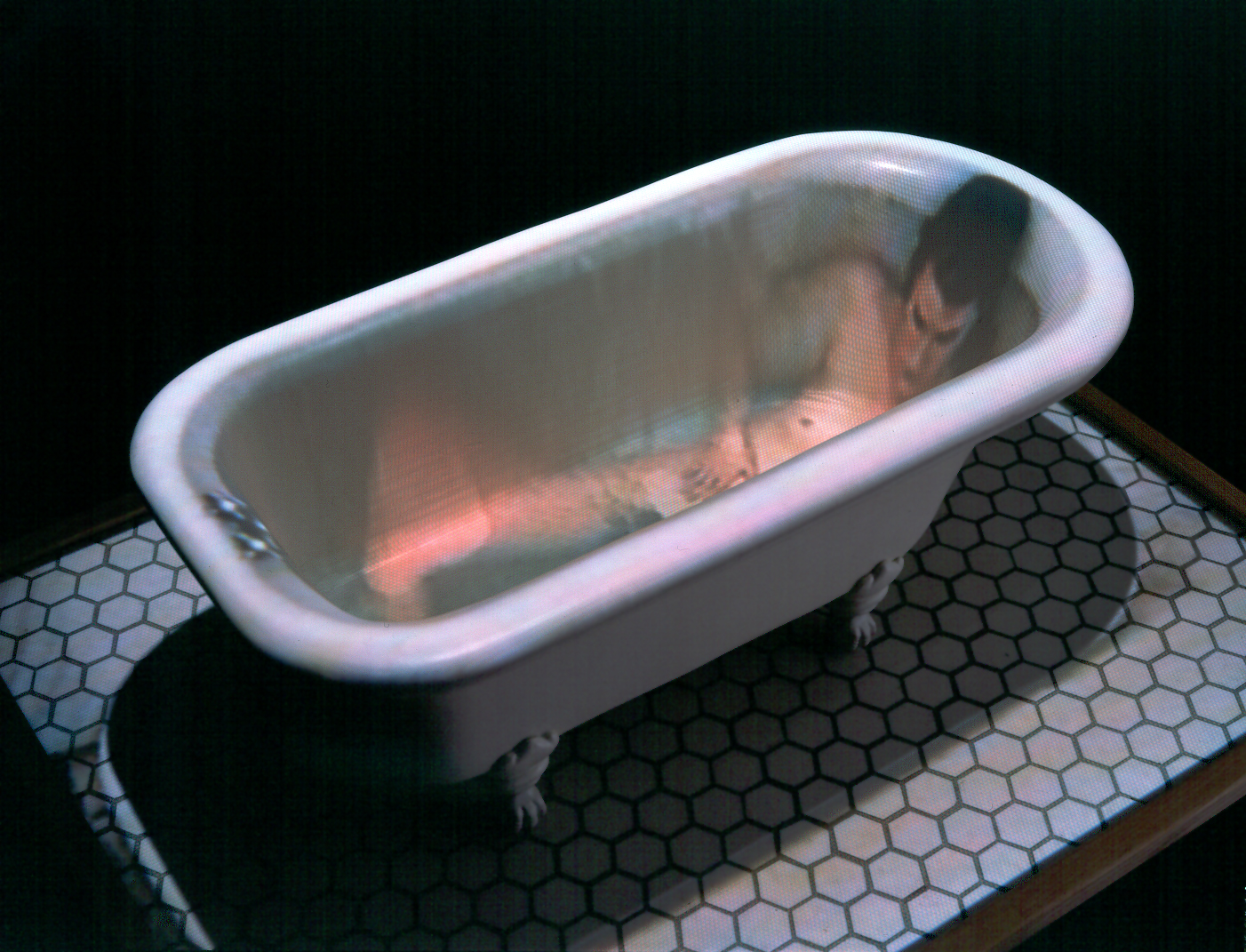
The projected image of blood-clouded water fills a miniature tub into which a woman climbs, crossing the static bounds of space and object. Slowly, one begins to notice the blood recede into her body, the water clearing. Bleeding every month is a defining female experience, yet in Ebb there is a shocking twist: she is taking back her blood. She gathers up her womanhood, disallowing the pain of menstruation and its sacrificial implications.
Installation Components:
–Video projection on miniature ceramic tub and tiled pedestal, audio; sculpture dimensions: 14h x 20w x 26d”; original running time: 4 minutes.
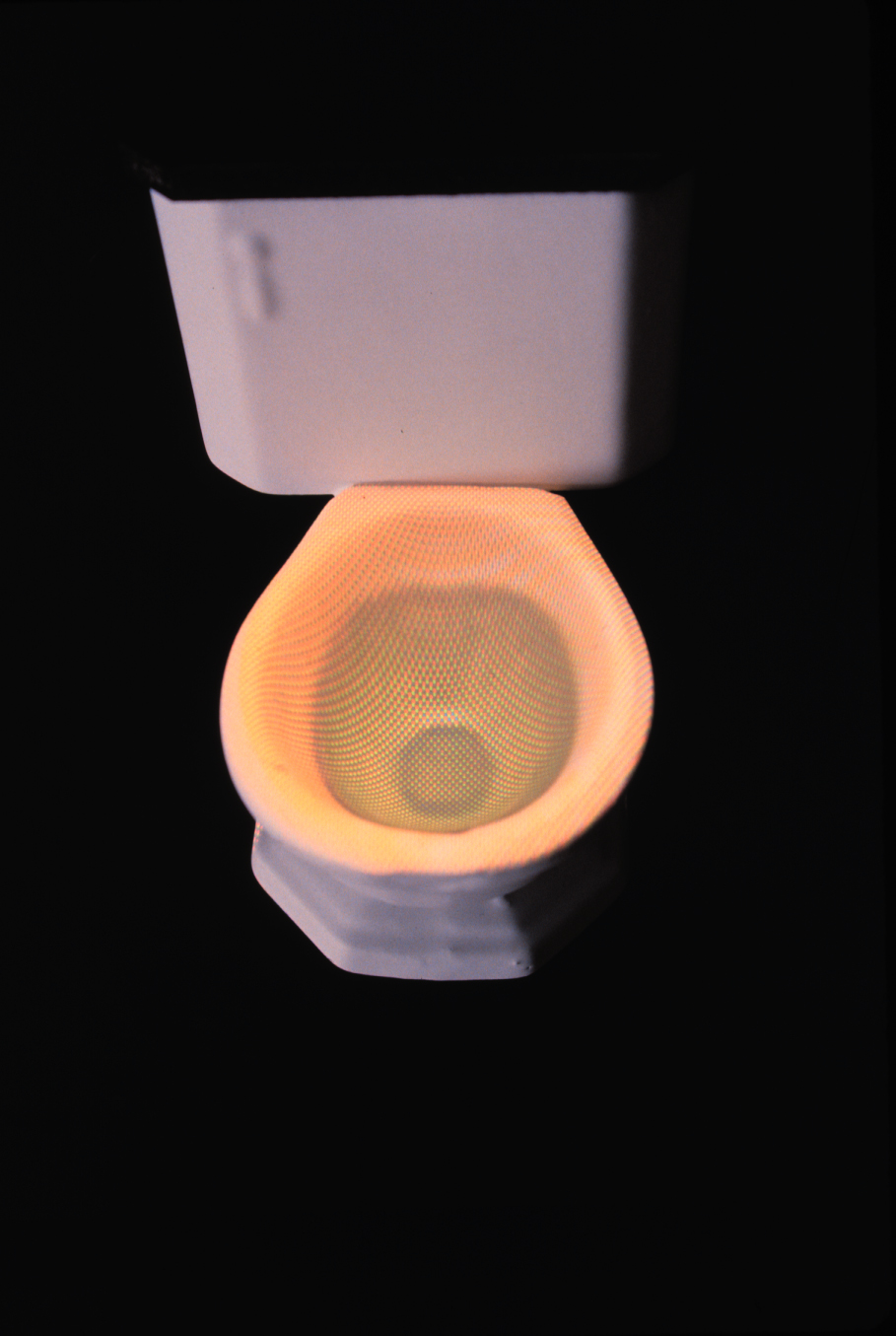
We illicitly land in the Men’s room, in front of an unenclosed toilet bowl. The projection fills the miniature bowl hung on the wall and spills onto the floor below. We stand within the projected video where he stands, our feet where his are, the tiny bowl just below our chin, and we peer in as the pee rings in the porcelain. We are the boy urinating; we are also the girl stealing a glimpse of this secret ritual.
Installation Components:
:–Video projection on floor and miniature ceramic toilet, audio; sculpture dimensions: 5h x 3w x 4 1/2d”; original running time: 2 minutes
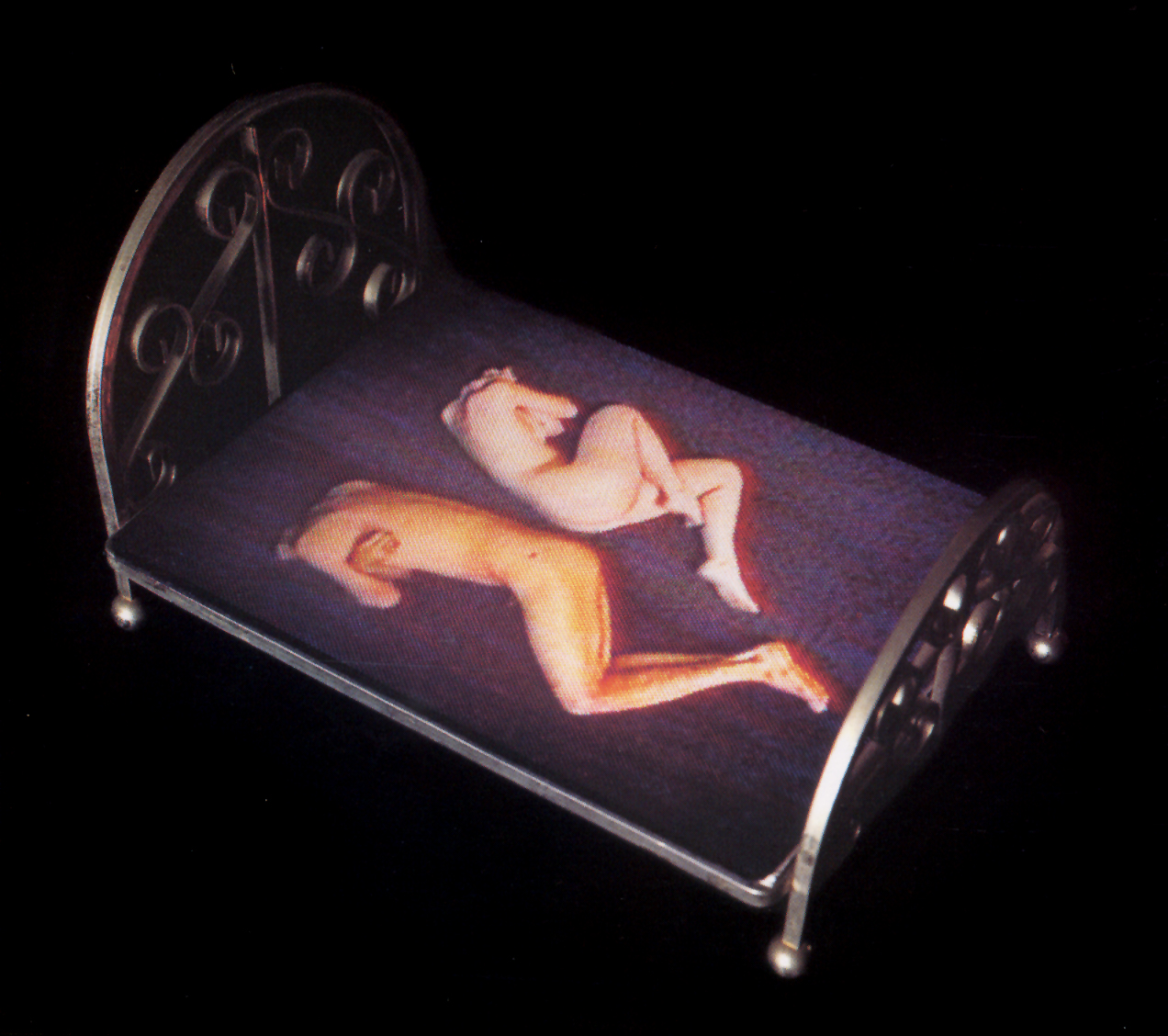
The image of a man and woman is projected onto a miniature wrought-iron bed. The female character achingly expresses her desire for her mate, but is met with rejection. Their fulfillment is incomplete, and our desire is likewise thwarted. Please is at once arousing, heartbreaking, and uncomfortably familiar; we suddenly recognize we have all at some time been characters in this story.
Installation Components:
–Installation components: video projection on miniature wrought-iron bed, audio;
sculpture dimensions: 3 3/4h x 5w x 7d”; original running time: 5 minutes
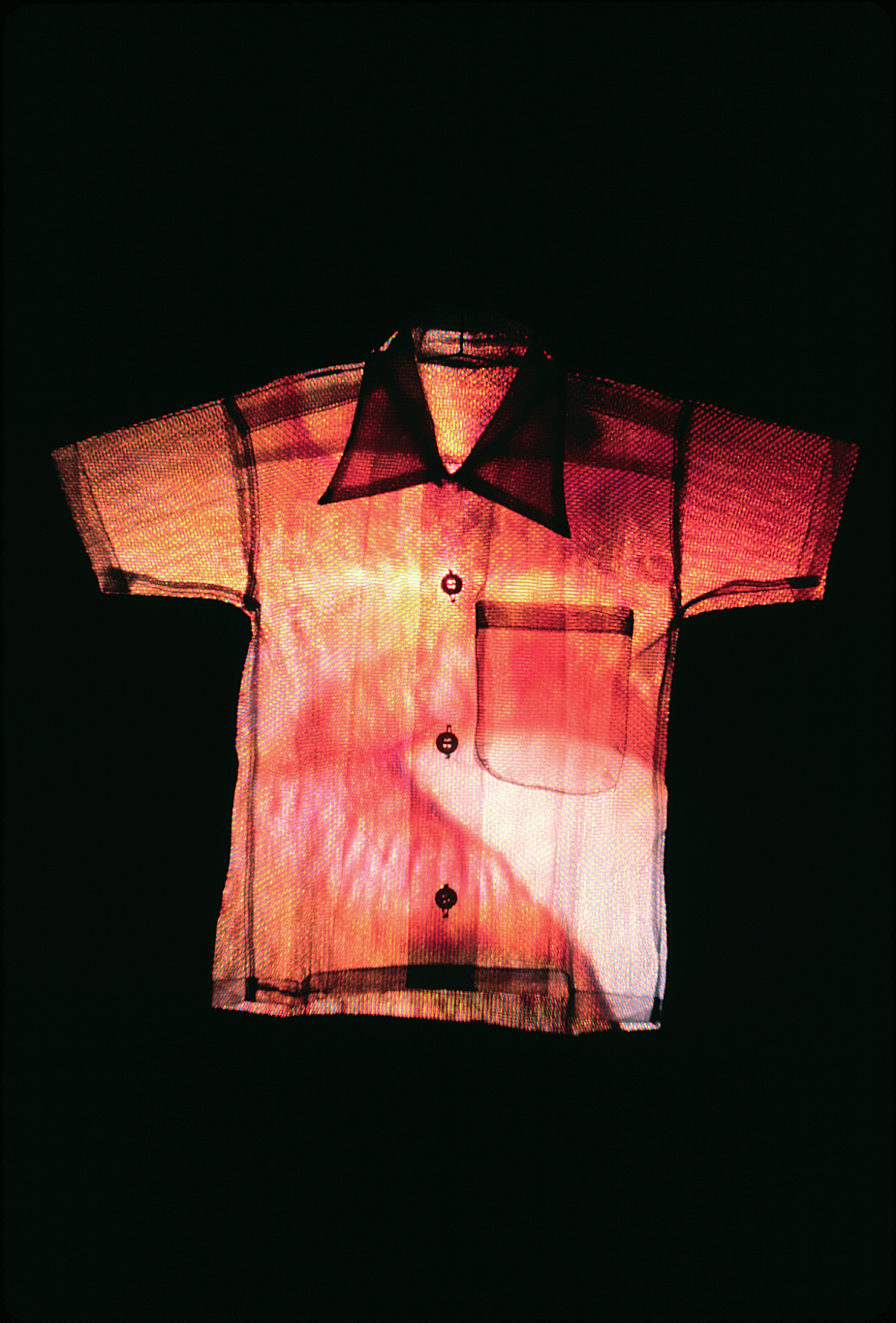
A mouth is projected onto a smaller-than-life-sized man’s button-down shirt. The girl slides her finger in and out of the boy’s mouth in exploration and in penetration. We feel the deep longing to be inside the other sex’s skin, to infiltrate the other. It is the impossible and compelling desire to know what we can never know.
Installation Components:
–Installation components: rear video projection on miniature transparent shirt, audio; sculpture dimensions: 17h x 18w x 1 1/2d”, original running time: 2 1/2 minutes
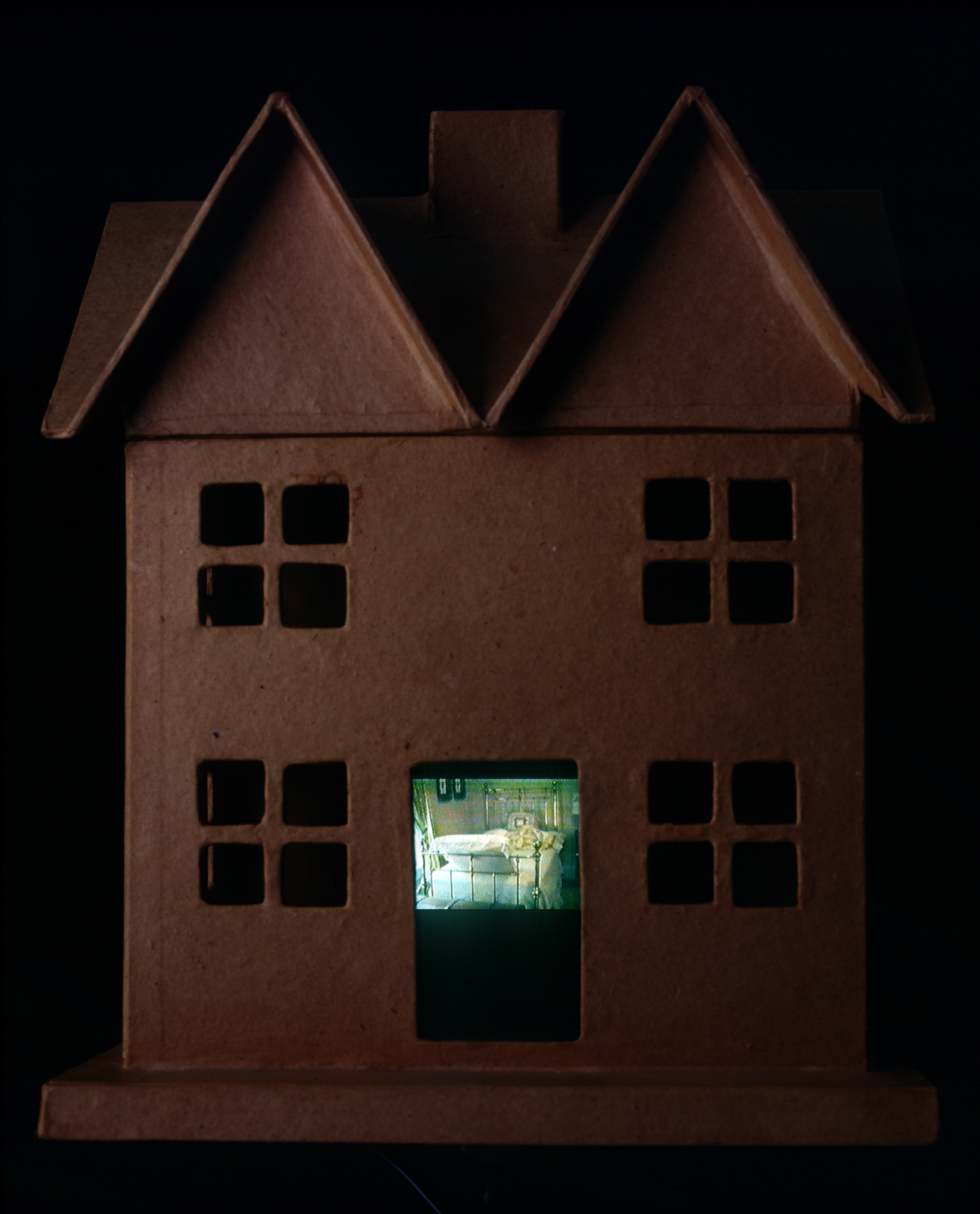
A tiny video monitor is contained within a paper house. The video shows a slow-motion tour through the narrator’s childhood home, while she recounts stories of her childhood auto-sexual experiments room by room, including those involving the living room chair, stairway banister, bathtub and brass bed.
Installation Components:
–Dimensions 68”h x 71/2”d x 9w”, including: pressed-paper house on metal stand, 3” LCD video monitor, and audio. Original running time: 4.5 minutes.